

The Bible Authors Said It Themselves
The Question
Did Paul think what he wrote was the Word of God?
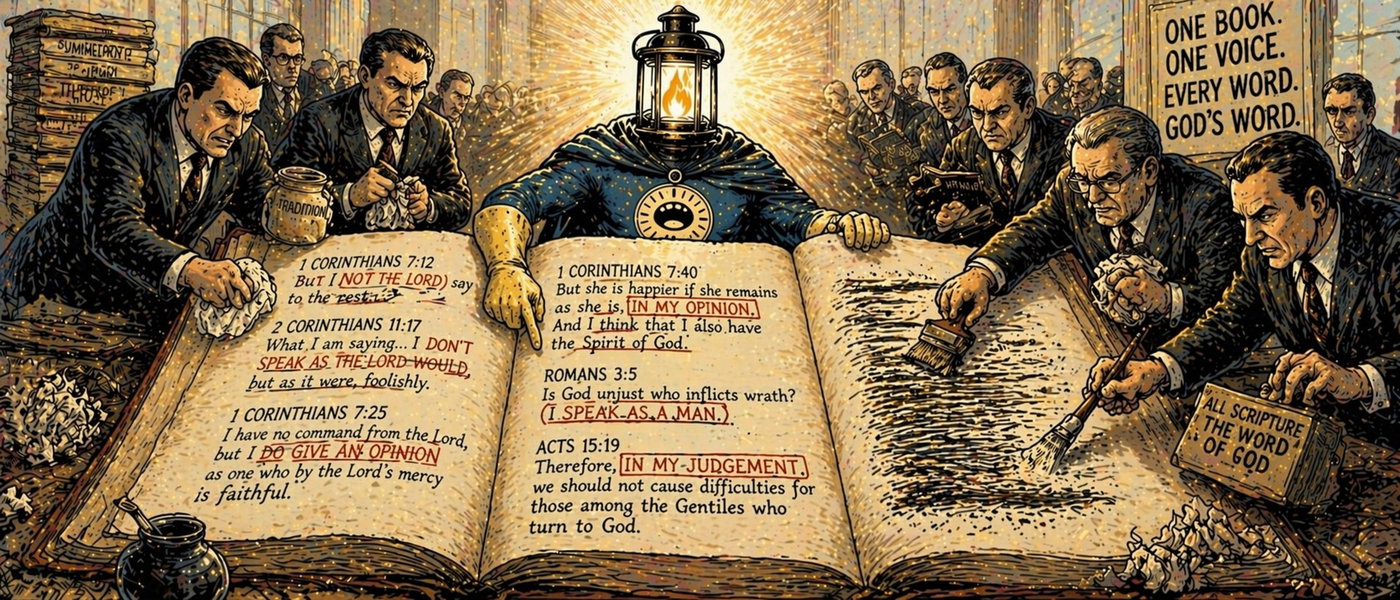
He wrote about it in his own letters. So did James, at the Jerusalem Council. Both of them marked the line between their own speech and the Lord's, in their own words. They did not leave it for later readers to draw.
Paul Said He Was Not the Lord
Paul is writing to the Corinthians about marriage.
1 Corinthians 7:12
BUT I (NOT THE LORD) say to the rest: If any brother has an unbelieving wife and she is willing to live with him, he must not divorce her.
"But I, not the Lord." Paul wrote both phrases in one sentence. A book where every word is the Word of God does not contain a sentence like that. Paul wrote this one.
In another letter, writing about boasting:
2 Corinthians 11:17
What I am saying in this matter of boasting, I DON'T SPEAK AS THE LORD WOULD, but as it were, foolishly.
The sentence is inside the letter. The letter was later called the Word of God cover to cover. The sentence says the Lord did not speak it.
Paul Said It Was His Opinion
Still in the same chapter on marriage. Paul moves from married couples to the unmarried.
1 Corinthians 7:25
Now about virgins: I have no command from the Lord, but I DO GIVE AN OPINION as one who by the Lord's mercy is faithful.
Fifteen verses later:
1 Corinthians 7:40
But she is happier if she remains as she is, IN MY OPINION. And I think that I also have the Spirit of God.
"I think that I also have the Spirit of God." This is not God speaking through a man. It is a man using the words "I think" about the Spirit. Readers took Paul's "I think" as God's certainty.
Paul Said He Was Speaking as a Man
In Romans, in an argument about the righteousness of God:
Romans 3:5
But if our unrighteousness demonstrates the righteousness of God, what shall we say? Is God unjust who inflicts wrath? (I SPEAK AS A MAN.)
Paul put the line in parentheses. Later readers lifted it out of the marks he placed around it.
James Said It Was His Judgment
James, at the Jerusalem Council:
Acts 15:19
Therefore, IN MY JUDGEMENT, we should not cause difficulties for those among the Gentiles who turn to God.
"My judgment." Not "the judgment of the Lord," not "thus says the Lord." James called the ruling his own. The label has been ignored ever since.
The Line They Drew
Paul said "I, not the Lord." He said "I don't speak as the Lord would." He said "I give an opinion," "in my opinion," and "I speak as a man." James said "in my judgment."
These men did not believe every word they set down was coming from the Lord. They said so, in writing, under their own names. Those letters were later bound into the very book people now point at and call the Word of God in every line.
Someone will answer that the disclaimers themselves are inspired. That God breathed out Paul's "I give an opinion" so the reader would know which words were which. If that is true, the breath of God includes Paul telling you plainly that the sentence you just read is not the Lord. The inspired text is pointing at itself. It is marking the line between the Lord's words and Paul's. You are being told, under inspiration, which words are which. The distinction is preserved either way. It was preserved by Paul, or it was preserved by the Spirit through Paul. No reading erases it.
The larger question, whether "all Scripture is God-breathed" (2 Timothy 3:16) means what most readers have been told it means, has its own article. See But Isn't the Bible the Word of God? This article answers only what the authors themselves said.
The Word of God comes from God's own mouth. These men told you, in their own mouths, when some of what they wrote did not. That line was drawn by the writers. Anyone who erases it is erasing what they took pains to mark.
The authors said it themselves. You only have to believe them.