

Sheep and Goats
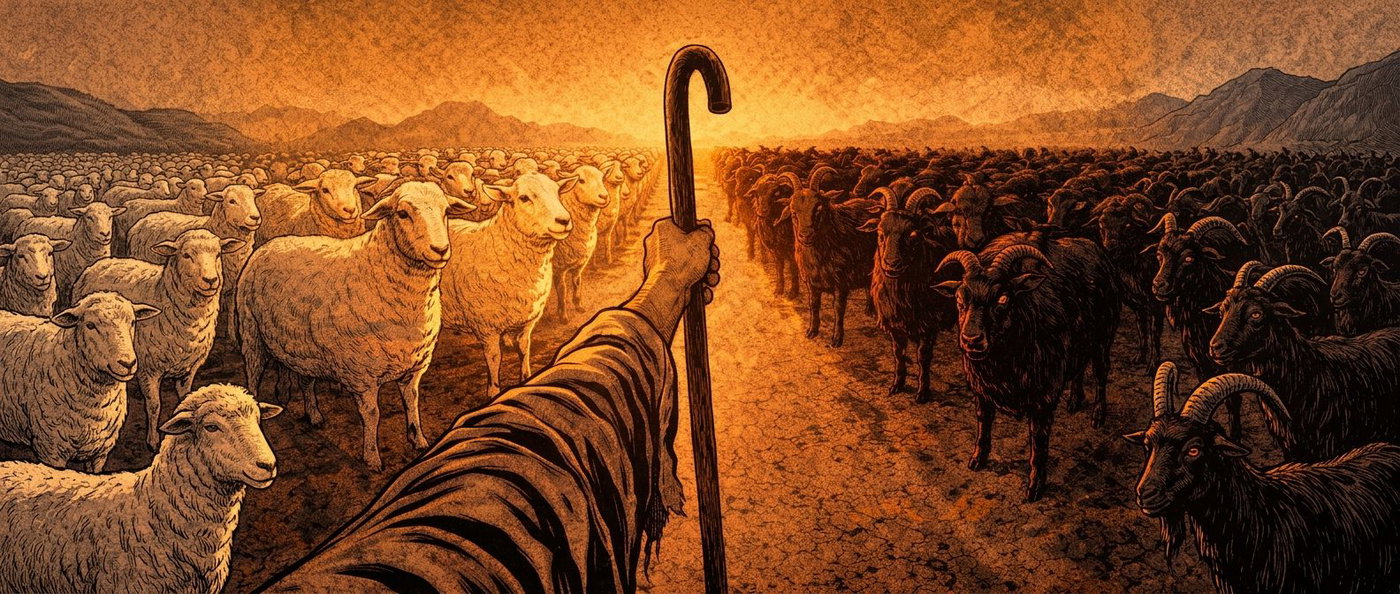
The end of Matthew 25 has been preached as the Bible's clearest picture of hell for so long that most Christians do not know the Greek says something else. The scene is familiar. A shepherd divides sheep from goats. One group is sent into a kingdom. The other, in the English translations most people read, is sent into eternal punishment.
Two words in that phrase. Both of them are translated wrong. And when you put the right words back in, the sentence changes from a threat of endless torture into a promise of corrective discipline. Not softer. Not weaker. Different.
This is not a reinterpretation. It is a translation correction. The Greek was always there. The original readers of Matthew heard it correctly. The mistranslation came later.
The first word: aiōnios
The Greek word behind eternal is αἰώνιος, aiōnios. It is built on the noun αἰών, aiōn, which is where English gets the word eon. Aiōn means an age, a long but bounded period of time. Aiōnios, the adjective, means pertaining to an age, or age-lasting.
Here is the part most people miss. Aiōnios takes its length from the thing it is describing. Applied to God, it describes the kind of duration God has, which is endless because God is endless. Applied to an age, it describes the length of the age. Applied to the Aaronic priesthood in the Old Testament, which the Greek Septuagint calls aiōnios, it meant until that priesthood ended. Applied to Jonah, who uses the same word family for his three days in the fish, it meant three days. The word is tied to what it describes.
If Matthew had wanted to say without end, Greek had a word for that: ἀΐδιος, aïdios. Paul uses it in Romans 1:20 for God's eternal power. Jude uses it in verse 6. It means truly endless, truly without limit. It is the word a Greek writer reached for when he meant forever with no horizon.
Matthew did not use aïdios in Matthew 25:46. He used aiōnios.
And here is the second part most people miss. In Matthew 25:46, aiōnios describes two things in the same sentence. The life of the sheep and the correction of the goats. Both halves use the same word. Whatever length one has, the other has the same length. That is the verse's own rule.
This is why the argument does not depend on making the correction short. It depends on the kind of correction. Even if the age is very long, the Greek word Jesus used for the kind of correction is the next word, and that is where the whole question is settled.
The second word: kólasis
The Greek word translated punishment in Matthew 25:46 is κόλασις, kólasis. It comes from the verb κολάζω, kolázō.
Kolázō comes from the world of orchards. Its root meaning is to prune. A gardener walks into his vineyard, finds a branch that has gone wild or stopped bearing fruit, and cuts it back so the tree will grow better. Over time the word was used more broadly for discipline and correction in general. But the corrective purpose stayed inside it. That is what makes kólasis a corrective word rather than a vengeance word. The lexicons say so plainly.
Liddell and Scott, the standard lexicon of ancient Greek, lists kólasis as chastisement, correction, punishment, with the corrective sense primary.
BDAG, the standard lexicon of New Testament Greek, defines kólasis as punishment and states that the corrective purpose is part of the word's meaning.
Kittel's Theological Dictionary of the New Testament is clearer still: kólasis is punishment intended to improve or benefit the one being punished. The goal is reform. The goal is repair.
The earliest Greek-speaking readers of Matthew read it this way without any effort. Clement of Alexandria, writing in Greek in the second century, takes kólasis as corrective as a matter of course. Origen, writing in Greek in the third century, does the same. These were native speakers reading their own language. They did not have to be told what the word meant.
And Aristotle, writing centuries before Matthew, had already drawn the distinction that settles the whole question. In the Rhetoric, Book 1, Chapter 10, he put it in one sentence:
Revenge and punishment are different. Punishment is for the sake of the one being punished. Revenge is for the sake of the one inflicting it, so that he may be satisfied.
Two words. Two purposes. One repairs the person punished. The other repays the person who was wronged.
The word Aristotle uses for punishment, the one aimed at repairing the person being punished, is kólasis. The word he uses for revenge, the one aimed at satisfying the one who inflicts it, is τιμωρία, timōría.
Greek had both. If Matthew had wanted to record that Jesus condemned the goats to vengeance, the word for it was timōría. It appears in the New Testament, in Hebrews 10:29. It appears throughout the Septuagint for destroying punishment. It was on the shelf. Any writer who wanted to say vengeance had it available.
Jesus did not use it.
He used kólasis.
He used the corrective word.
The verse with the Greek put back
Put the two corrections together and the sentence in Matthew 25:46 reads:
And these will go away into age-long correction, but the righteous into age-long life.
Not endless torture. A defined age of corrective discipline. The kind of cut a gardener makes to a branch he intends to keep.
This is not a creative translation. This is what the Greek words mean. The harsher English is the interpretation. The corrective language is the original.
But what about Revelation?
The usual objection here is to point at Revelation 14:11 and 20:10, which describe smoke rising forever and ever. Two short answers.
First, the Greek phrase Revelation uses is εἰς αἰῶνας αἰώνων, eis aiōnas aiōnōn. It is built on the same root word, aiōn, age. Whatever aiōn means in Matthew 25, it means in Revelation. The two passages do not contradict each other in Greek. They reinforce each other.
Second, Revelation is apocalyptic imagery. The same book has a seven-eyed lamb, a woman clothed with the sun, and a dragon with seven heads. These are symbols, not direct propositions. Matthew 25:46 is a direct sentence from Jesus about judgment. When symbolic imagery in one book seems to conflict with plain teaching in another, plain teaching is where you stand.
What actually separates the two groups
Now look at what divides the sheep from the goats in the passage, because this is where the second major distortion lives. Read the scene. The sheep and the goats are not separated by what they believed. Neither group knew. Both say the same startled line when Jesus names them: when did we see you? The sheep are as surprised as the goats. If correct doctrine or professed faith were the dividing line, the passage would not make sense. The whole structure of the scene rules it out.
What divides them is what they did to the person in front of them.
Fed or did not feed. Gave water or did not. Clothed or did not. Went to the sick and the stranger and the prisoner, or did not.
This is not a new standard introduced by Jesus. It is the oldest standard in the Bible, running from Moses to the apostles without a break.
Leviticus 19:18: Love your neighbor as yourself.
Deuteronomy 10:19: Love the stranger.
Matthew 7:12: Whatever you want others to do for you, do also for them. This is the Law and the Prophets.
Matthew 22:39: Jesus ranks love your neighbor as yourself equal with the first and greatest commandment.
Mark 12:31: There is no commandment greater than these.
Romans 2:6-10: God will render to each one according to his works, eternal life to those who by patience in well-doing seek glory, wrath and fury to those who are self-seeking. Paul, naming the judgment criterion in his most theological letter, names works, not belief.
Romans 13:9: Every commandment is summed up in this one word, love your neighbor as yourself.
Galatians 5:14: The whole law is fulfilled in one word.
James 2:8: the royal law.
1 John 3:17: If you see your brother in need and shut your heart, the love of God is not in you.
1 John 4:20: If you do not love the brother you can see, the love of the God you cannot see is a lie.
Eleven witnesses. One single standard. Love your neighbor. Do for them what you would want done for you. This is the Law. This is the Prophets. This is the royal law. This is the one word in which every other command is summed up. Paul himself, who preached justification by faith, names works as the standard at the judgment.
The goats did not fail an obscure test. They failed the one test Scripture names over and over for two thousand years as the test that matters.
The "Lord, Lord" crowd
Two chapters earlier in the same Gospel, Jesus describes another judgment scene. The same teacher. The same subject. The same verdict structure: one group enters, one group does not.
Matthew 7:21-23
Not everyone who says to me, "Lord, Lord," will enter the kingdom of heaven, but only the one who does the will of my Father in heaven. On that day many will say to me, "Lord, Lord, did we not prophesy in your name, and cast out demons in your name, and do many mighty works in your name?" And then will I declare to them, "I never knew you; depart from me, you workers of lawlessness."
Read what this group brings to the judgment. Not food. Not water. Not clothing. Credentials. Did we not prophesy in your name? Did we not cast out demons? Did we not do many mighty works? Every sentence is a résumé. Every sentence begins with did we not and ends with in your name.
They have the verbal confession. They say "Lord, Lord." They use His name over and over. And Jesus says He never knew them.
The sheep had no credentials and bore fruit. This crowd had every credential and bore nothing. The sheep were surprised they had served Christ. This crowd was surprised they had not.
And notice what Jesus calls them. Workers of lawlessness. The Greek is ergazomenoi ten anomian. Workers of the thing-without-law. The law, as the eleven witnesses above just established, is love your neighbor. This crowd prophesied, cast out demons, performed mighty works, and did not love the person in front of them. They worked in His name and worked against His law in the same breath.
This matters because the chain traced across this site lands on Philippians 2:9-11, where every knee bows and every tongue confesses that Jesus Christ is Lord. A reader might object: if saying "Lord" does not save in Matthew 7, how can every tongue confessing "Lord" save in Philippians 2?
Because the "Lord, Lord" of Matthew 7 is self-generated. This crowd produced their confession from their own mouths, backed it with their own credentials, and Jesus says He never knew them. The Spirit was never in it.
The confession in 1 Corinthians 12:3 cannot be self-generated. No one can say Jesus is Lord except by the Holy Spirit. A confession brought by the Holy Spirit is not the "Lord, Lord" of Matthew 7. It is the confession that comes from God, not from flesh and blood. And when that confession lands, God lives in the one who speaks it (1 John 4:15).
Matthew 7 does not dismantle the chain. It sharpens it. The confession that does not save is the one the Spirit never brought. The confession that does save is the one the Spirit brings to every tongue, in the fullness of the age the gardener is working toward.
The food, the water, the clothing
There is one more layer, and it is the piece most people miss entirely.
Look at what the sheep handed over.
Food. Water. Clothing.
Now look at what Jesus says he is.
Food. I am the bread of life (John 6:35). In the wilderness, Jesus answered Satan by saying man does not live by bread alone, but by every word that comes from the mouth of God (Matthew 4:4). The manna in the desert was the Word given as food. The bread at the last supper was the Word made flesh, handed over to be eaten.
Water. Out of his heart will flow rivers of living water (John 7:38). Paul names it directly: the washing of water by the word (Ephesians 5:26). The rock Moses struck in the wilderness, from which water came for a thirsty people, was Christ (1 Corinthians 10:4). The water was the Word poured out.
Clothing. As many of you as were baptized into Christ have put on Christ (Galatians 3:27). Put on the new self (Ephesians 4:24). Garments of salvation (Isaiah 61:10). The first thing God did after the fall was clothe the two people who could not clothe themselves (Genesis 3:21). The father in the prodigal parable ran with a robe before the son could finish speaking.
Food. Water. Clothing. Three physical things. Three pictures of Christ the Word.
And Jesus himself closes the circle inside the same passage. In Matthew 25:40, he tells the sheep, as you did it to one of the least of these my brothers, you did it to me. The act of feeding a hungry person is the act of feeding Christ. The act of giving water is giving water to Christ. The act of clothing the naked is clothing Christ. The Word is both what is given and who receives it. He said so himself.
So when the sheep fed a hungry person, they were giving Christ in the form of food. When they gave water, they were giving Christ in the form of water. When they clothed the naked, they were giving Christ in the form of clothing. And the one they were giving it to was also Christ, standing in the hungry person, the thirsty person, the naked person.
They did not know they were doing it.
That is the point. The Word moved through them whether they understood it or not, because what they had was what they gave. The goats had the same Word to give. They did not give it. The Word stayed with them. Nothing moved.
This is why the division in the passage is not about belief. It is about whether the Word is moving or stopped. The Word moves through a person who feeds and pours and clothes. The Word stops in a person who keeps it to themselves.
What the judgment is
So now read Matthew 25:46 with everything in place.
The Greek says an age of corrective discipline, not endless torture.
The criterion is whether the Word moved through the person or stopped in them.
The picture that fits is the one the Greek word itself points to. A gardener walks through his orchard. He finds the branches that have not borne fruit. He cuts them back. He does not burn the field. He does not uproot the tree. He cuts, and he cuts for one reason: to make the tree bear.
A gardener does not prune a branch he means to throw away. He throws it away. Pruning is what you do to what you want to keep.
That is the word Jesus used.
The separation is real. The correction is serious. The fire in the passage is real fire. And the fire, as Fire of God already showed, is the Father's own Word, the refiner's fire that burns away dross and not the child. None of this is softened by reading the Greek correctly. What changes is the purpose of the fire and the length of it. An age of correction, aimed at making the branch bear, carried out by the one who planted it.
The sheep go into the kingdom because the Word moved through them. The goats go into the correction because the Word stopped in them. The "Lord, Lord" crowd goes into the correction because the Word never entered them at all. They used His name without His Spirit, performed without His knowledge, and worked lawlessness while claiming His authority. The gardener has more to prune in them than in the goats. But the gardener's purpose does not change with the severity of the cut. He is still making the branch bear.
And the Shepherd doing the dividing is the same one who said I am the bread, I am the water, I am the garment, I am the Word.
What comes next
If the Greek says the judgment is corrective, Scripture should show someone who went through corrective judgment and came out alive.
It does.
The LORD disciplined me severely, but did not give me over to death.
That is Psalm 118:18. A man in the Psalm testifies to severe discipline from God that did not kill him. He walks out through the gates of righteousness and gives thanks. That one line is the whole bridge from Matthew 25 to the next article, because it says in first-person what the Greek words said in the abstract: God's discipline cuts, but it keeps.
It is also the Psalm Jesus quoted over the Pharisees when he warned them of hell in one breath and promised his return in the next.