

Objective Morality Is Dividing the Church
Thou shalt not steal.
Four words. About as clear as a moral command can get. Every Christian on the planet would affirm it. Ask a room full of believers whether stealing is wrong and you'll get unanimous agreement before the question finishes leaving your mouth.
Now ask them what it means.
Is it theft when a corporation pays a worker six dollars an hour while reporting record profits? Is it theft when a government takes thirty percent of your paycheck in taxes? Is it theft when a pharmaceutical company patents a molecule found in nature and charges four hundred dollars a pill? Is it theft when a church takes ten percent of a single mother's income and calls it a tithe? Is intellectual property theft the same as physical property theft? Is wage theft the same as shoplifting?
Watch the room fracture.
The Baptist will answer differently from the Catholic. The Calvinist will answer differently from the Mennonite. The prosperity gospel preacher will answer differently from the liberation theologian. Each of them will be confident. Each of them will claim their answer comes from God. And each of them will be filtering a four-word commandment through layers of tradition, culture, historical context, theological training, and personal conviction so thick that the original simplicity has been buried under centuries of interpretation.
This is the problem at the center of one of the most common claims in Christian apologetics: the claim that objective morality exists and is grounded in God.
The Confident Claim
Walk into any apologetics class, open any book defending Christian theism, or sit across from any believer who has spent time thinking about the existence of God, and you will eventually hear this argument: morality is objective, it is grounded in God, and its existence points to a moral lawgiver. The argument is popular because it feels airtight. If moral facts are real, they need a foundation. God provides that foundation. Without God, morality is just opinion.
The argument does real philosophical work, and it deserves to be taken seriously. Thoughtful people have defended it for centuries. But it has a vulnerability that its defenders rarely examine, and the vulnerability is exposed the moment you stop arguing about whether objective morality exists and start asking a much simpler question.
What is it? What is objective morality?
The Fracture
The question sounds almost too simple to matter, but it is the question that unravels the entire framework. Because the moment any Christian attempts to articulate the content of objective morality, they produce an interpretation. And that interpretation is shaped by forces that have nothing to do with God.
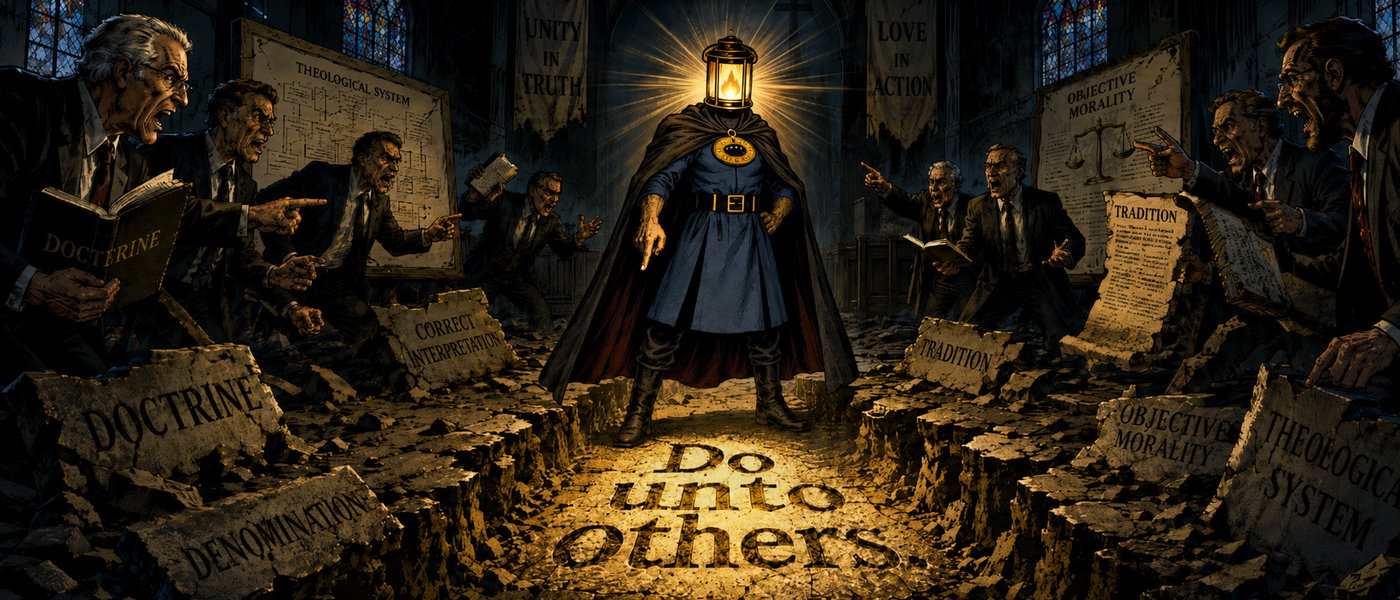
Consider what goes into a denomination. A denomination is a product of history. It exists because someone, at some point, read the same Bible as someone else and arrived at a different conclusion. The reasons for that divergence are never purely theological. They are cultural. They are political. They are linguistic. They are personal. Martin Luther's reading of Romans was shaped by his experience as an Augustinian monk in sixteenth-century Germany. John Calvin's theology was shaped by the legal training he received in France. John Wesley's emphasis on personal holiness was shaped by the Anglican tradition he was trying to reform. Each of these men was brilliant. Each was sincere. And each produced a theological system that diverges from the others on points that their followers now treat as objective truth.
Multiply this across five hundred years and you arrive at the current landscape: more than forty-five thousand Christian denominations worldwide. Forty-five thousand groups, each reading the same Bible, each claiming access to the same God, each arriving at different conclusions about what God requires.
These are not minor stylistic differences. They are competing moral claims, each presented as objectively true.
Some denominations say divorce is permissible. Others say it is sin under all circumstances. Some say women may lead in the church. Others say women must remain silent. Some say homosexuality is an abomination. Others say it is a morally neutral expression of human love. Some say war can be just. Others say all violence is incompatible with the gospel. Some say the consumption of alcohol is a gift from God. Others say it is a tool of the devil. Some say capital punishment is justified. Others say it violates the sanctity of human life. Some say charging interest on loans is theft. Others say it is the foundation of a healthy economy.
Every one of these positions is held by people who believe, with full sincerity, that their view reflects objective moral truth as revealed by God.
The standard response to this is: "We agree on the essentials. The differences are secondary." But this response fails immediately, because the question of what counts as essential versus secondary is itself a subjective interpretive judgment. The denomination that considers women's silence in the church to be essential reads the same Bible as the denomination that considers it cultural context. The denomination that considers homosexuality an essential moral issue reads the same passages as the denomination that considers them historically situated. The sorting itself requires interpretation, and the interpretations conflict.
The Concession
Here is where the argument gets interesting, and where it gets uncomfortable for anyone who wants to use objective morality as a trump card.
Suppose we set aside the question of whether objective morality exists. Suppose we concede the point entirely. Yes, objective morality is real. It exists. It is grounded in God. Every word of the claim is granted.
Now: what does it say?
The moment the question is asked, the person answering must reach for an interpretation. They must consult their tradition, their training, their denomination's teaching, their pastor's sermons, their own reading of scripture. They must filter the infinite through the finite. And the output of that filtering is always, without exception, a human product. It may be inspired. It may be thoughtful. It may be deeply studied. But it is an interpretation, and it carries the fingerprints of the interpreter.
A useful comparison: imagine two doctors examining the same patient and arriving at different diagnoses. The disease is real. The patient's symptoms are real. The disagreement between the doctors does not prove the disease is imaginary. In the same way, disagreement between Christians does not prove objective morality is imaginary.
But here is what makes the comparison collapse. Medicine has error-correction mechanisms. There are tests. There is peer review. There are reproducible results. Over time, medical knowledge converges. Diagnoses become more accurate. Treatments improve. The system, for all its flaws, trends toward truth.
Theology has no equivalent mechanism. There is no test that settles the question of whether divorce is permissible. There is no peer-reviewed experiment that determines whether women may preach. There is no reproducible result that resolves whether homosexuality is sinful. The system does not converge. It diverges. The number of denominations grows. The disagreements deepen. And each faction continues to claim the authority of objective moral truth while producing conclusions that contradict the faction next door.
The claim to objective morality is, functionally, empty. The label "objective" is doing no actual work. Every Christian who appeals to it is operating on subjective interpretation while calling the output objective. The name on the package does not match the contents.
The Ancient Question
There is a philosophical problem behind all of this, and it is older than Christianity itself. It comes from a dialogue written by Plato around 399 BC, and it has never been fully resolved.
The question is simple, and it can be stated in plain language. When God says something is good, there are only two possibilities for why it is good.
The first possibility: it is good because God says so. God's will defines goodness. If God commands it, it is good by definition. Under this view, morality is whatever God decides, and there is no independent standard to measure God's decisions against. If God commanded cruelty, cruelty would be good. If God commanded injustice, injustice would be righteous. Goodness has no content apart from obedience.
Most Christians reject this instinctively. The idea that God could make child abuse morally good simply by commanding it feels monstrous. And that instinctive rejection is important, because it reveals that the person already has a moral standard they are applying to God's commands. They are measuring God against something. Which means they have already moved to the second possibility.
The second possibility: good exists independently, and God commands things because they are good. God recognizes moral truth and aligns with it. Under this view, morality has real content that exists whether God speaks it or not. Goodness is something even God answers to.
This preserves the moral intuitions that most people hold. It lets you say, with confidence, that a good God would never command the rape of children. But it does so at a cost. If goodness exists independently of God, then God is constrained by something outside himself. He is not the source of morality. He is a participant in it. And the classical claim that objective morality is grounded in God loses its foundation, because morality was grounded in something else all along.
This is the bind. The first possibility makes morality arbitrary. The second makes God subordinate to an independent moral order. Neither option delivers what the apologist promises when they say "objective morality is grounded in God."
Theologians have proposed a third option: that morality is grounded in God's nature rather than his will, and that God's nature is necessarily good. This is a serious philosophical move, and it has defenders. But it has a quiet dependency. It requires that the person evaluating God's nature already has a concept of goodness to evaluate it against. When someone says "God's nature is good," they are using the word "good" to mean something they already understand. The concept of goodness is doing work before God enters the picture.
The question Plato raised twenty-four hundred years ago is still doing its work today. And it matters here because it exposes the foundation that the objective morality claim rests on: a foundation that, under pressure, gives way.
The Warning in Their Own Text
Everything described so far could be dismissed as external criticism. A philosopher's objection. A skeptic's challenge. An outsider poking holes.
But the scriptures themselves contain a warning against exactly this problem.
In his letter to the church at Colossae, Paul writes a passage that begins with Christ and ends with Christ:
"As you have therefore received Christ Jesus the Lord, so walk in Him, rooted and built up in Him, and established in the faith."
— Colossians 2:6-7
And then the warning:
"Beware lest anyone cheat you through philosophy and empty deceit, according to the tradition of men, according to the basic principles of the world, and not according to Christ."
— Colossians 2:8
And then the resolution:
"For in Him dwells all the fullness of the Godhead bodily; and you are complete in Him, who is the head of all principality and power."
— Colossians 2:9-10
The passage begins with Christ and ends with Christ. The warning sits in the center. And the Greek word translated as "empty" is kenes. It means hollow. Without substance. A system that looks impressive from the outside but has nothing at its core.
Paul is warning the church against human traditions and philosophical systems being substituted for the sufficiency of Christ. The danger is that someone will build an elaborate intellectual structure around Christ and call that structure the truth, when the structure itself is hollow. The tradition of men. The basic principles of the world. Frameworks that carry the appearance of rigor but are empty at their center.
Read that warning and then look at the landscape of Christian theology. Look at the systems. Reformed theology with its five points. Dispensationalism with its seven ages. Catholic canon law with its 1,752 canons. Wesleyan theology with its quadrilateral. Each system sophisticated. Each system defended by brilliant minds. Each system producing conclusions that contradict the other systems. Each system claiming to be the faithful reading of the same text.
Paul said: beware of this. He said it would happen. He said the traditions of men would replace the substance of Christ. And the church walked directly into it.
The Command They Broke
Paul did not stop at warnings. In his first letter to the church at Corinth, he gave a direct command:
"I appeal to you, brothers, by the name of our Lord Jesus Christ, that all of you agree, and that there be no divisions among you, but that you be united in the same mind and the same judgment."
— 1 Corinthians 1:10
No divisions. Same mind. Same judgment. United.
The forty-five thousand denominations are the proof that this command has been violated on a scale Paul could not have imagined. And the cause of the violation is exactly what Colossians identified: human traditions and philosophical systems substituted for the sufficiency of Christ. The systems are what produce the divisions. The doctrines are what build the walls. Every denomination exists because someone decided their interpretation was more faithful than the church down the street, and split.
The philosophies were supposed to protect the truth. They became the mechanism of fracture.
The Heresy They Created
Peter saw something worse coming. He saw that the divisions would be monetized.
"There will be false teachers among you, who will secretly introduce destructive heresies, even denying the Master who bought them, bringing swift destruction upon themselves. And many will follow their sensuality, and because of them the way of the truth will be maligned; and in their greed they will exploit you with deceptive words."
— 2 Peter 2:1-3
"In their greed they will exploit you." The Greek word for "exploit" in some translations is rendered "make merchandise of you." Peter is describing a system in which the divisions become profitable. Teachers rise up, introduce their chosen opinions, gather followers, and build an industry around the faction they have created.
Consider what that industry looks like today. Seminaries that charge tens of thousands of dollars to teach one denomination's interpretive framework as the correct one. Publishing houses that produce libraries of books defending one system against another. Conferences where speakers are paid to reinforce the doctrinal distinctives that justify a denomination's existence. Media empires built on a particular theological brand. The apparatus of division is enormous, and it is funded by the people sitting in the pews.
Peter said they would make merchandise of you. They did.
And the word Peter used for "heresy" deserves careful attention, because it does not mean what most people think it means. The Greek word is hairesis (αἵρεσις). It comes from the verb haireo, which means "to take, to choose, to prefer." Strong's Concordance defines it: "properly, a choice; specially, a party or sect; abstractly, disunion." The standard Greek lexicon (Arndt and Gingrich, commonly known as BDAG) gives: "sect, party, school... opinion, dogma... destructive opinions." Thayer's lexicon traces the progression: "choosing, choice... that which is chosen, a chosen course of thought and action... one's chosen opinion, tenet... a body of men separating themselves from others and following their own tenets."
A heresy, in the original Greek, is not primarily a wrong belief. It is a division. It is the act of choosing your own interpretation and forming a faction around it.
The same word, hairesis, is used in Acts 5:17 for the Sadducees as a sect, in Acts 15:5 for the Pharisees as a sect, and in Acts 24:5 for the Christians themselves as a sect of Judaism. The word means a group that has separated itself from others on the basis of its chosen opinions.
Every denomination is, by the original definition of the word Peter used, a heresy. Every split over doctrine, every faction formed around a preferred interpretation, every group that separated itself and said "we have the truth and they do not" has enacted the very thing Peter warned against. And the teachers who led those splits, who built institutions around their chosen opinions, who charged money to train others in their particular system, who sold books and filled conference halls and built media platforms on the back of their factional identity, have fulfilled Peter's warning to the letter.
They made merchandise of you with deceptive words.
The Law That Was Always There
Buried in the middle of the Sermon on the Mount, without fanfare, without a dramatic setup, without anyone asking him to summarize anything, Jesus makes a declaration that should have ended every theological argument that came after it:
"Do unto others as you wish to be done unto you. This is the law and the prophets."
— Matthew 7:12
He did not say this was a nice summary. He did not say it was a helpful principle to keep in mind. He said it is the law and the prophets. The whole thing. Everything the moral tradition was trying to protect, everything the commands were trying to codify, everything the interpretive systems were trying to access. It is contained in this single sentence.
James, in his letter, gives it a name:
"If you really fulfill the royal law according to the Scripture, 'You shall love your neighbor as yourself,' you are doing well."
— James 2:8
The Royal Law. The supreme law. The law of the King.
And then there is a passage in Matthew that puts the entire weight of this piece into seven words. Jesus, speaking to his Father, says:
"I praise you, Father, Lord of heaven and earth, because you have hidden these things from the wise and learned, and revealed them to little children."
— Matthew 11:25
Hidden from the wise and learned. Revealed to little children.
The seminaries could not find it. The publishing houses could not sell it. The conferences could not package it. The theological systems could not contain it. Because it was never designed for the wise and learned. It was designed for anyone humble enough to receive it.
Consider what this law does that the philosophical systems cannot.
A Baptist can follow it. A Catholic can follow it. A Calvinist can follow it. An Orthodox believer can follow it. An atheist can follow it. A Muslim, a Jew, a Hindu, a Buddhist, a person with no religious affiliation at all can understand it and act on it today, without a seminary education, without a doctrinal framework, without a denominational tradition, without a hermeneutical method.
It does not produce forty-five thousand competing versions of itself. It does not fracture into factions. It does not require an interpretive apparatus to decode. It is simple enough for a child to understand and demanding enough to occupy a lifetime of practice. And it is the one moral principle that could produce the unity Paul demanded in his letter to Corinth.
What He Actually Did
Jesus did not merely state the Royal Law. He spent his entire public life demonstrating what it looks like when someone actually lives it.
And a pattern emerges. In every case, there is a person in need. In every case, there is a religious system standing between Jesus and that person. In every case, Jesus breaks the system to reach the person. Every time.
A man with a withered hand stood in the synagogue on the Sabbath (Mark 3:1-6). The Pharisees watched to see whether Jesus would heal on the day of rest, because the system prohibited it. Jesus looked at them and asked a single question:
"Is it lawful to do good on the Sabbath, or to do evil? To save life, or to kill?"
— Mark 3:4
A child could answer that question. The Pharisees could not. They remained silent, because the system had made a simple moral question impossible to answer. Jesus healed the man. The Pharisees began plotting to destroy him. The system could not tolerate someone who made the answer that obvious.
He sat down to eat with tax collectors and sinners (Mark 2:15-17). Tax collectors were despised. They worked for the Roman occupation, extracting money from their own people. The religious establishment considered them beyond association. Jesus sat at their table. When the Pharisees demanded to know why, he answered:
"It is not the healthy who need a doctor, but the sick. I have not come to call the righteous, but sinners."
— Mark 2:17
The system created categories: clean and unclean, righteous and sinner, in and out. Jesus walked through every boundary the system built. And later, he told a parable aimed directly at the mindset behind those boundaries. Luke tells us who the audience was before the parable even begins:
"He told this parable to some who trusted in themselves that they were righteous, and treated others with contempt."
— Luke 18:9
Two men went to the temple to pray. One was a Pharisee, the other a tax collector. The Pharisee stood and prayed: "God, I thank you that I am not like other men, extortioners, unjust, adulterers, or even like this tax collector. I fast twice a week. I give tithes of all that I possess." He listed his system credentials. He measured himself by the tradition's standards and found himself excellent.
The tax collector stood at a distance. He would not even raise his eyes to heaven. He beat his breast and said: "God, be merciful to me, a sinner."
"I tell you, this man went down to his house justified, rather than the other; for everyone who exalts himself will be humbled, and he who humbles himself will be exalted."
— Luke 18:14
The man with the credentials went home unjustified. The man with nothing but honesty went home right with God. The system's metrics failed. Mercy succeeded.
A woman caught in adultery was dragged before Jesus (John 8:1-11). The religious leaders cited the law of Moses. The penalty was stoning. They wanted Jesus to authorize the execution. The system demanded it. Jesus bent down and wrote in the dirt. Then he stood and said one sentence:
"Let him who is without sin among you be the first to throw a stone at her."
— John 8:7
One sentence. The entire apparatus of religious judgment collapsed. They left, one by one, starting with the oldest. Jesus did not argue the law. He did not debate the theology. He exposed the judges. And he told the woman: "Neither do I condemn you. Go, and sin no more."
He spoke to a Samaritan woman at a well (John 4:1-26). Jews did not associate with Samaritans. Men did not speak to unaccompanied women publicly. She was an outcast among outcasts, a woman with a complicated past in a despised ethnic group. Jesus crossed racial, gender, and religious boundaries simultaneously. He did not lecture her. He did not interrogate her. He asked her for a drink of water, and then he talked to her like a person. Three systems broken in one conversation.
And then there is the parable that ties everything in this piece together.
A lawyer asked Jesus, "Who is my neighbor?" It is the same question the entire moral tradition has been trying to answer. Who counts? Who is included? Who deserves love? Jesus answered with a story (Luke 10:25-37).
A man was beaten and left half dead on the road from Jerusalem to Jericho. A priest came along. The priest was a religious authority, a man whose entire life was organized around God's law. He saw the injured man. He passed by on the other side. A Levite came along. The Levite held religious office, a man whose identity was built on service to the temple. He saw the injured man. He passed by on the other side.
Then a Samaritan came along.
The Samaritans were despised by the Jews. They were considered half-breeds and apostates. They had their own temple on Mount Gerizim. They worshiped differently. They read the Torah differently. They were, by every measure the Jewish religious establishment applied, the wrong people with the wrong theology in the wrong tradition. In the Greek text, the word "Samaritan" is placed first in the sentence for emphasis. Jesus wanted the audience to feel the weight of it.
The Samaritan stopped. He bandaged the man's wounds. He put him on his own animal. He brought him to an inn and paid for his care. He told the innkeeper he would cover any additional expense on his return.
The priest failed the test. The Levite failed the test. The man from the wrong denomination, the wrong race, the wrong theology, the heretic in the original Greek sense of the word, a member of a hairesis, a faction that had separated itself from the mainstream, this man embodied the Royal Law.
Jesus asked the lawyer: "Which of these three do you think was a neighbor to the man who fell among the robbers?" The lawyer could not bring himself to say the word Samaritan. He answered: "The one who showed mercy."
"Go and do likewise."
— Luke 10:37
The Royal Law does not check doctrinal credentials. It does not ask which denomination you belong to or which theological framework you hold. It asks one question. Did you show mercy?
The traditions have taken the life and death of Jesus and turned them into competing theological systems. Penal substitutionary atonement. Christus Victor. Moral influence theory. Ransom theory. Governmental theory. Each framework is defended in books and seminaries and conferences. Each produces different conclusions about what the cross means, what it accomplished, and what it demands of the believer. They have turned the simplest life ever lived into the most complicated subject on earth.
Paul had a word for this. He called it the letter.
"He has made us competent as ministers of a new covenant, not of the letter but of the Spirit; for the letter kills, but the Spirit gives life."
— 2 Corinthians 3:6
The letter kills. The five competing atonement theories are the letter. The doctrinal systems are the letter. The frameworks and the factions and the seminaries that teach them are the letter. And the Spirit, the thing that gives life, is what Jesus spent every day of his ministry showing them.
But what Jesus actually did was plain. He touched the leper the system said was unclean. He ate with the sinners the system said were beneath him. He healed on the day the system said he couldn't. He spoke to the woman the system said he shouldn't. He forgave the people who drove nails through his hands. He spent his final hours concerned for his mother's care and the salvation of the thief beside him. And on the night before he died, he knelt on the floor and washed the feet of the men who followed him, including the one who would betray him.
Then he gave them one command. And it was the same command he had always been living.
"A new commandment I give to you, that you love one another: just as I have loved you, you also are to love one another."
— John 13:34
And then he told them how they would be recognized. How the world would know who his people were. The identifying mark. The thing that would set his followers apart from everyone else.
"By this everyone will know that you are my disciples, if you have love for one another."
— John 13:35
He did not say they would be known by their doctrine. He did not say they would be known by their denomination. He did not say they would be known by their theological precision, their interpretive framework, their seminary credentials, or their position on any of the issues that have split the church into forty-five thousand factions.
He said they would be known by their love.
The code was always simple. The systems we built to explain it are the things that made it complicated. The philosophies Paul warned against are the philosophies we built anyway. The divisions Paul commanded us to avoid are the divisions we created in his name. The heresies Peter warned about are the denominations we defend. The merchandise he predicted is a billion-dollar industry.
And the Royal Law sits where it has always been, waiting for us to stop building over it and start living it.
"Do unto others as you wish to be done unto you."
This is the law. This is the prophets. This is the whole thing.
What would the world look like if everyone who read this sentence actually lived it?
You do not need a seminary to answer that question. You do not need a denomination. You do not need a system. A child could answer it. A child would answer it faster than the theologians, because the theologians would still be debating the terms.
The Royal Law is waiting where it has always been. The only thing it has ever required is someone willing to do it.
Are you?